Guide · Buying
Sony A7 III vs A7C, Used
How a used Sony A7 III and a used A7C differ in the hand: card slots, the viewfinder, the screen, and which body to buy when the lenses are the same.
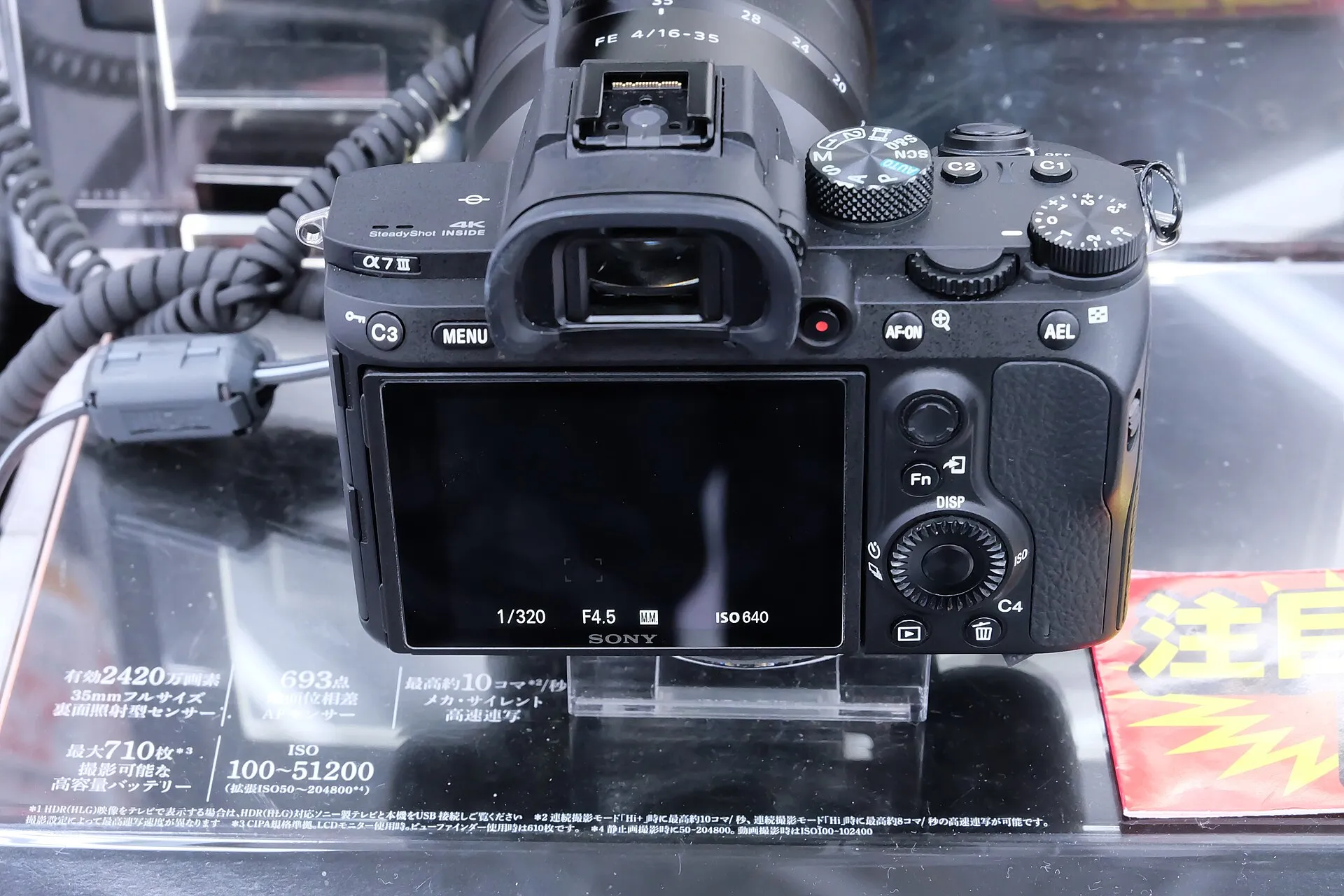
The Sony A7 III and the A7C get mixed up because the files look alike and the batteries are the same. Sony described both as a 24.2-megapixel full-frame camera. Both take the NP-FZ100. Both mount every full-frame E lens. That is where the sameness ends. One is a two-card body with a viewfinder you can live in. The other is a smaller camera with one card slot and a screen that flips out.
This page is the buying difference. It is not a price. Each product page shows a measured asking range when one exists and stays blank when it does not. Read the listings in front of you, then use the differences below to decide whether the cheaper body is actually the one you want.
What you are actually choosing
You are choosing a shape, a viewfinder, and a backup plan for the card.
The A7 III is the larger of the two. It has a grip you can get a hand around, a joystick, and two SD slots. Slot 1 is UHS-II. The screen tilts up and down. It does not swing out to the side. The viewfinder is the one people mean when they say a Sony finder is fine.
The A7C is the smaller body, announced in 2020. The viewfinder is the little one in the corner. There is one card slot. The screen flips to the side, which is the feature people buy it for when they record themselves or shoot at the hip. The grip is shallower. A heavy zoom makes the balance more obvious than it does on the A7 III.
If you already know you hate small finders, stop here and buy the A7 III. If you already know you will not carry a camera that does not fit a small bag, stop here and buy the A7C. The rest of this page is for the person who could live with either.
The sensor is not the argument
Both are 24.2-megapixel full-frame cameras in Sony’s description. You will not see a resolution gap in a normal print or a normal online photo. People who need more file for a crop are shopping a different body, such as the A7R III or the A7 IV. People who need 4K at 60p are also shopping a different body. Neither of these two does 60p in 4K. Both top out at 4K 30p.
That is useful, because it takes the spec-sheet argument away. You are not paying for more pixels. You are paying for the body wrapped around the same kind of file.
Cards, and the day a card fails
The A7 III writes to two cards. You can split raw and JPEG, or you can have the second card catch the same files. It is the difference between a wedding photo that still exists and a conversation you do not want to have.
The A7C has one slot. Sony did not hide a second one. If a listing brags about dual slots, it is not an A7C. One slot is acceptable for travel, for a walk, and for work where the files are not irreplaceable the moment the shutter closes. It is a bad fit for a job where losing the card loses the job.
Ask which card is in the box. A fast card is part of the camera you think you are buying. A tired card that came with the body in 2018 is not.
The viewfinder and the screen
This is the part you cannot judge from a title.
The A7 III’s finder is large enough that a day of shooting through it is normal. The A7C’s finder is the compromise that made the camera small. Some people adapt in an afternoon. Some people return the camera. If you can hold both, look through both before you pay. If you are buying from a listing, watch a clip of someone putting the A7C to their eye, and be honest about whether you squint.
The screens are the opposite trade. The A7C flips to the side and faces forward. That is the video camera, and it is the camera for a photo taken from the ground without you lying in it. The A7 III’s screen tilts. It is fine for a shot from the waist. It is awkward for a piece to camera. If you record yourself, the A7C is the one of these two that was built for that.
Neither screen is a reason to ignore a cracked hinge. A hinge that flops is the repair, on both bodies.
Handling, including the lens you will actually use
A small body feels smaller until the lens is on it. An FE 24-105mm f/4 G OSS is a sensible one-lens kit for either camera, and it is not a light lens. On the A7 III the grip takes it. On the A7C you will support the lens with your left hand the whole time, which you should do anyway, and you will notice the body tipping forward in a bag.
A small prime changes the story. An FE 50mm f/1.8 on an A7C is the combination people mean when they say the A7C disappears. The same prime on an A7 III is still a good camera. It is just not the small one.
Stabilization is in both bodies. You do not buy the A7C to gain it, and you do not buy the A7 III to gain it. The lens’s own OSS, on a zoom that has it, works on either.
What the listings get wrong
Separate the cameras before you compare asking prices.
- ILCE-7M3 is the A7 III. ILCE-7C is the A7C. A title that says “A7C” and shows a camera with a deep grip and a joystick is the wrong camera.
- The A7C II and the A7C R are later bodies. ILCE-7CM2 and ILCE-7CR are not this page. The names differ by a character.
- “Low shutter” is a claim. Sony does not show the count in the menu. Ask for an original file and read it. The shutter-count guide is the procedure. Electronic frames often never appear in the mechanical count.
- A kit is a different product. A body with a 28-70mm zoom is not a body price. Do not average it into the body you are comparing.
- Two cards in the description means it is not an A7C. One card slot in the description of an “A7 III” means you should look at the photos again.
Then look at the two product pages. A measured range, when the page has one, is a spread of asking prices on eBay.com, not a sold price. A blank means there were not enough clean listings to publish a number. Either way, the body in the photos is the thing you are buying.
Which one to buy used
Buy the A7 III when the pictures matter enough that a second card is worth the size. Buy it when you shoot through the finder, when the camera hangs on a strap all day, or when the lens is a zoom you will not take off. The extra bulk is the feature.
Buy the A7C when you will carry it because it is smaller, when the flip screen is how you shoot, and when one card is a risk you have already accepted. Do not buy it to get a better sensor. You will not. Do not buy it because a listing calls it the newer A7. Newer, in this pair, means smaller and one slot.
If the two asking prices are close, the A7 III is the easier camera to keep. If the A7C is meaningfully cheaper and you have held the finder, take the saving. If you have not held the finder, do not assume you will like it because the files match.
A later body is a different question. The A7 IV is the step up in resolution, finder, and 4K 60p, and it is usually a step up in asking price. Use that page when 24 megapixels is the thing you have already decided against. Use this page when 24 megapixels is enough and the only decision left is the shape of the camera.
Where to look
These searches are the two bodies, limited to used condition on eBay. They are someone else’s asking prices, not a measured range from this site, and not a sold price.
As an eBay Partner, we may earn a commission from qualifying purchases. Read the disclosure.
Questions
Do the A7 III and the A7C use the same battery?
Yes. Both take the NP-FZ100. A charger and a spare from one body work in the other.
Can I tell them apart from a listing title?
Only if the title is honest. ILCE-7M3 is the A7 III. ILCE-7C is the A7C. ILCE-7CM2 is the later A7C II, which is a different camera. Ask for a photo of the top plate if the title says only “Sony A7.”
Which one is better for video?
Neither records 4K at 60p. The A7C’s screen flips to the side, which is the practical video difference. The A7 III’s screen only tilts, and it has the larger viewfinder and a second card slot.
Will the same lenses fit both?
Yes. Both are full-frame Sony E-mount. A lens that fits an A7 III fits an A7C, including the FE 24-105mm f/4 G OSS and the smaller primes.